

MESSAGE – IN THE VALLEY OF DEEP DARKNESS
Sunday Message, 03.14.21
FOURTH SUNDAY IN LENT
SCRIPTURE READING Psalm 23
As the Church of Christ we are called to be as broadly and fully inclusive as we can. And we struggle with that in many ways, large and small.
In addressing a group, do we say brothers, or brothers and sisters, or siblings? Or just friends, as I often do, because for me that word siblings seems strained and strange and devoid of emotional impact.
And nowhere is this struggle more true than in our talk about God.
Today we are thinking about that familiar Psalm:
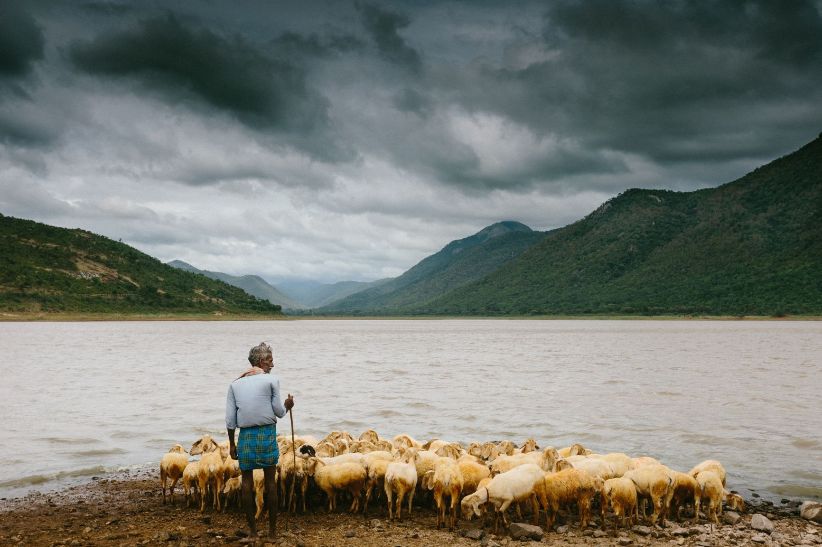
The Lord is my shepherd…
Does that not reinforce the dangerous idea of God as the old guy with the long beard painted on a ceiling by Michelangelo? An old, white guy, even.
And can we say, “Father…” or should we say Creator? Father is kind of sexist, and some folks have life histories that make father an image mixed with varying degrees of discomfort, fear; the anger and angst we might have about absence and undependability and so on.
But Creator does not have much of an emotional impact at all, for good or bad, for most of us.
And in hymnody these issues are all magnified by our familiarity, or lack thereof, with the antique language of much of our poetry, and the question of to what extent is it helpful. or even permissible, to tinker with it. It’s one of the reasons we have in our pews two hymnbooks, a red and a black.
A good example of the problem that this creates for us is that familiar song, How Great Thou Art. It didn’t even make the cut for the red hymnbook, which was printed in the 1970’s, copyright 1974. I guess folks at that time thought it was too pietistic for the likes of us.
But then there was a clamoring for a new and more inclusive hymnbook. And so we have
O, Lord my God, when I in awesome wonder,
Consider all the worlds thy hands have made,
I see the stars, I hear the rolling thunder,
Thy power, throughout the universe displayed.
which becomes in the black book version
O mighty God, when I survey in wonder
The world that formed when once the word you said…
It doesn’t exactly roll off the tongue.
And then there’s today’s first hymn. Well, what do we do with that? I have an older version of it,
Come Thou almighty king
Help us thy name to sing,
Help us to praise, Father, all glorious,
O’er all victorious…
Then we have versions of it, that want to do away with the Elizabethan language, that make it
Come now almighty king.
Or versions of it, like in the black book, which say
Come now almighty God…
Because we don’t want to use that masculine King word, and I get what they are trying to do. But somehow “come now almighty king, help us thy name to sing” just moves me in a way that “help us your name to laud” does not.
What do we do about this dilemma?
We tread dangerously when we say, The Lord is my shepherd…
Is God this sort of masculine protector? And is that fair and useful? But on the other hand, do we want to sacrifice the assurance and hope that come to us so vividly through that familiar shepherd image?
Think about how Jesus mines that in the gospels to talk about himself as the good shepherd…
Think about that wonderful parable of the lost sheep where he envisions himself in the shepherd who leaving the 99 safe in the fold goes out to search for the one that is lost.
Now it’s kind of interesting because one of the ways he phrases that is to say, “Which of you having 90 and 9 safe in the fold would not go look for the one…”
And over that years I’ve had people tell me, “Now wait a minute, you’d leave the 90 and 9 unprotected to search for the one? Let him go!”
But Jesus says, “No, I am like the shepherd that goes out and searches far and wide high and low until that one lost sheep is found.”
I saw a cartoon this week that works that theme in kind of an interesting way. In the picture, you have Jesus carrying a sheep on his back, And the fleece of that sheep has been painted in the colors of the rainbow flag. An unhappy, grumpy, disgruntled looking bunch of sheep saying, “He wasn’t lost, we kicked him out!”
And Jesus says, “Don’t worry, I found her.”
1The LORD is my shepherd;
I shall not want.
That is meant to give to us a picture of this kind of God who cares so tenderly and completely for us. If we need to translate the language into some other imagery to make it speak to people’s hearts, I am all for that.
But if can mine that imagery and use it to speak to us in our situation, I am all for that as well.
So often we read these verses at funeral services, and usually I use the King James version because that’s what many in the audience are most familiar with:
2He maketh me to lie down in green pastures:
he leadeth me beside the still waters.
3He restoreth my soul:
he leadeth me in the paths of righteousness for his name’s sake.
4Yea, though I walk through the valley of the shadow of death, I will fear no evil:
It’s interesting to me that a more accurate translation of that part of the Psalm might be
“even though I walk through a valley of deep darkness…”
Not necessarily the shadow of death, perhaps the shadow of death, but the darkness that settles upon us for many reasons.
I find it kind of ironic that as we are recording this service today the sun is shining brightly through the windows and it’s wonderful. But many of us are feeling, still hovering over our spirits, a kind of darkness that almost touches on despair, because of the year that we have been through.
It was one year ago this Sunday that we rather abruptly called off our services of worship and said, “No we cannot safely gather.” At the time we assumed that that would just be a matter of weeks or maybe a couple of months. But it very quickly became clear that it was going to go on and on and on.
And here we are a year down the road, still recording and streaming and broadcasting and desperately longing to have the company of other human beings, siblings, brothers and sisters friends to worship with.
When will that be happening?
We pray it will be soon, we fear it will not be for a long time. We are still in that limbo that could very well be summarized as that valley of deep shadow.
But this psalm of hope says to us that no matter how deep the shadow, no matter how long the journey, there is hope on the other side.
And that’s what we need to hang on to.
Last week we celebrated communion Sunday. And one of the things I talk about whenever we do communion is how that table set before us points us in hope, being in our minds eye a pledge and foretaste of the feast of love which to come when we are all gathered around God’s great banquet table.
5Thou preparest a table before me in the presence of mine enemies:
thou anointest my head with oil;
Now that always seems like kind of a creepy image to me because I don’t want oil poured on my head, thank you. But what they’re getting at in the context of the day is grooming, you know, putting a little dab on your head so that you can comb your hair and make it look proper and not be all scraggly and disheveled.
Thou annointest my head with oil,
my cup runneth over.
What a powerful picture that is: that God is going to pour out for me not just as much as I need but more than I can even use.
6Surely goodness and mercy shall follow me all the days of my life:
and I will dwell in the house of the GOD for ever.
Savior like a shepherd lead us,
Much we need thy tender care.
Indeed.
In the name of God,
Our Creator, Redeemer and Sustainer.
Amen.